
Goldsmiths' Fair 2026: Part One
Goldsmiths' Fair 2026: Part One
This year I went to Goldsmiths' Fair for the first time, armed with a notebook, a camera and a rather extensive list of items I wanted to pay attention to. I didn't really use the camera much. By the end of the first week I’d talked to roughly 22 people about their jewellery and vessels, about their methods, about authorship and provenance, how long they’d been showing at Goldsmiths’ Fair and what an event like this genuinely means to them. The conversations naturally flowed in different directions based on the person and the task at hand, which was exactly what I was hoping for.
I’m a graphic designer and brand strategist working with founder-led jewellers and craft makers in Ireland and the UK including goldsmiths, silversmiths and other independent creative businesses. Much of my work and research is on the things that can be difficult to communicate when someone has been working in their own practice for years. How something is manufactured, where the value is, who authored it, what the customer understands, and what may be unseen. Thinking about all of those things, the Goldsmiths’ Fair was a really rich place.
It was also my first time in Goldsmiths' Hall, which was an experience in itself. From the outside it is relatively simple, and then you come inside and you are surrounded by gilded ceilings, elegant rooms and a building that feels almost more like a historic collection than a contemporary jewellery exhibition. And then you look at the work. The Fair provides the jewellery space in a really efficient way. The stands have a uniform structure, the makers are easily defined and nothing seems to be feverishly vying for your attention. The work is free to speak, which felt especially right in a setting where so much of the value is in the person and process behind the finished piece.
As soon as I could I was talking about process. I spoke to Gill Galloway-Whitehead about her use of wire. She creates a long scroll of wire to the height needed for a setting so she can make numerous pieces from the same length. She has worked for around 21 years and strangely she too started with a degree in graphic design before turning into jewellery. It was one of those conversations when knowing how something is made changes your perspective of the finished product. You stop seeing a thing and you see the judgements, planning, material knowledge and years of skill that went into it.
That was time and time again. I kept questioning myself, where does authorship really live? It was extremely intriguing to watch the diverse ways of creating. Some people set their own stones, others go to specialised setters. Others cast elsewhere, others work with textiles, glass or enamel, some utilise CAD, and others have devised wholly unique processes of their own. There was a shared understanding in the room that the process underpinning the term 'handmade' carries far more weight than the word itself suggests. Ultimately, a work can have true artistic authorship even if it wasn't physically fabricated by the maker at every stage. Authorship can be found in the decisions, the design, the intervention, the judgement, the material knowledge and the particular way somebody perceives and responds to a piece.
The first person I stopped to chat to was Alex O’Connor therefore she will always be number one in my Goldsmiths’ Fair experience. 😂 She studied art at Kingston, then a friend introduced her to a silversmithing workshop and her practice grew from there. We talked about the evolution of practices, how makers represent themselves and what happens when a body of work is more complicated than the original language used to describe it. She has been showing at the Goldsmiths’ Fair for many years and has seen the Fair itself develop over the years, and also the wider changes in jewellery education, and the numbers of places available to master speciality skills. That made me think of something else: when a course disappears, it's not only the loss of a course. You may also be losing a way that a skill is passed on.
Other conversations were much more about the link between maker and material as a personal one. Jane Moore's work attracted me because of the colour, but when I got closer I started to notice the little changes within the enamel, I saw a blue piece where the transition between nite and day was so delicate that you only truly saw it when you looked closely. We had a great conversation about her courses in Kilkenny and how she greatly enjoys the actual experience of teaching and demonstrating process over giving presentations or webinars. That made sense to me, having spent some time at the Fair. There are things that you grasp differently when you are physically standing next to a creator, looking at the item and hearing them explain what they do.
Susannah King was another sort of talk altogether. She was one of my favourites since chatting to her was like being back at art college with someone who got my jokes straight away. We started off with a green tourmaline ring and were chatting about colour, stone setting, her studio and how she works with her team. One stone may transform the whole character of a ring," she said. Setting the stones personally is one of the portions of the process she enjoys most. There are three bench jewellers who work for her and she has taught them the procedure from beginning but she keeps the rings for herself because, as she put it, she is the boss and has first dibs. 😂
And of course we also talked about lime green. I loved that there was a small pouch of green slime stuck to her business card, and then I noticed the bright green glasses and knew this wasn’t just a colour that had shown somewhere on a moodboard. It was, of course, her universe. I might have said that she was really committed to the lime and the jeweller next to her laughed. And in fact, those little moments are what I find so exciting as a brand strategist. Sometimes the best signals about a founder-led business aren’t the things that someone has explicitly written down. They are the things they naturally keep picking, wearing, making and surrounding themselves with.
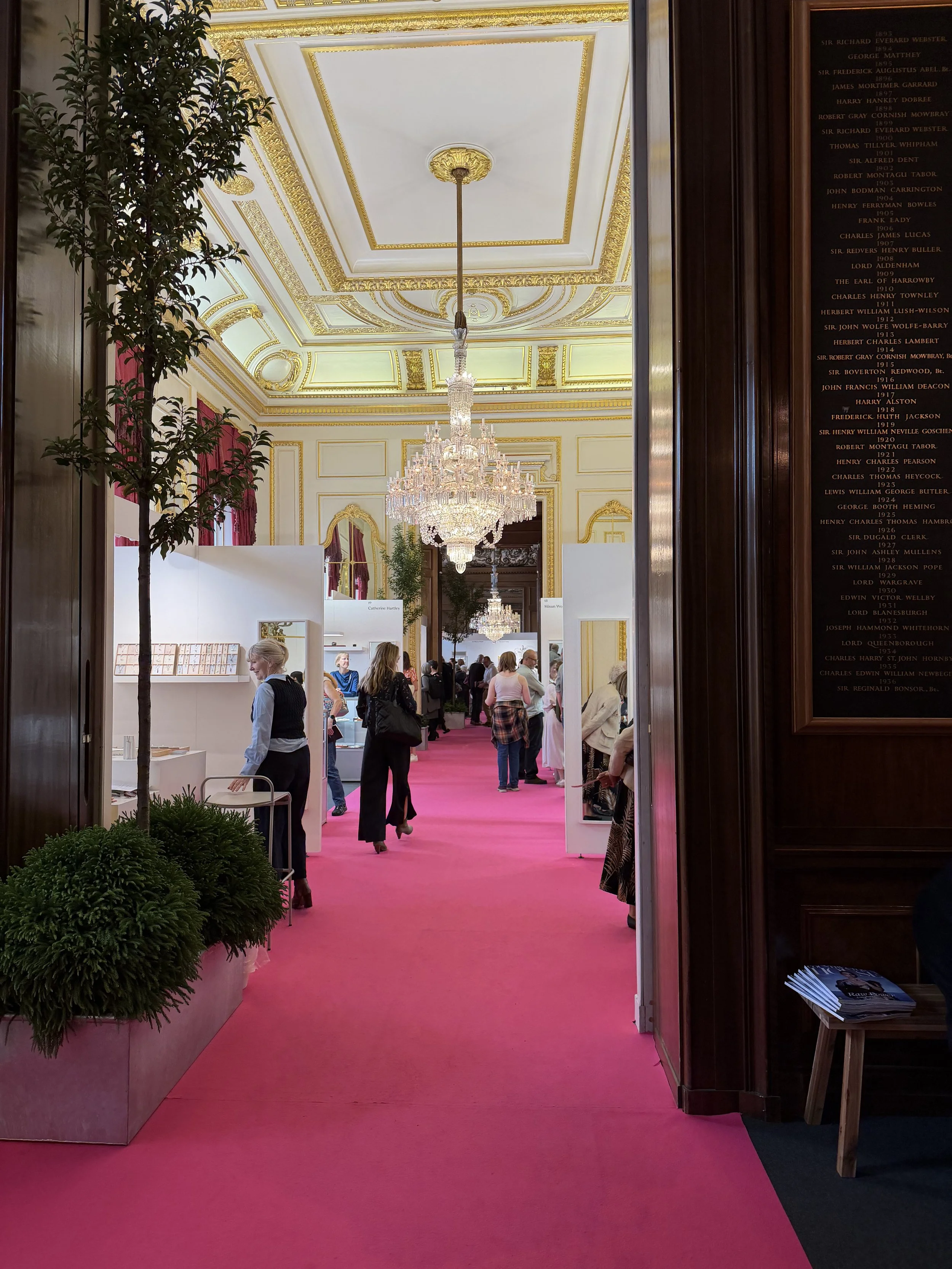
Goldsmith Fair 2026 exhibition in full swing.
During the week I chatted to people who had been showing at Goldsmiths’ Fair for years, and others who were much newer to it. There were makers who had taken career breaks and come back to jewellery, people whose practices had transformed into something quite different from where they started, people combining jewellery with teaching, workshops, sculpture or other materials, and people whose websites were more like portfolios than shops. Over many days I learned about education, websites, international shipping, customers, materials, exhibitions and the practicalities of running a creative business. The talks weren’t all saying the same thing, but they offered me a much more full image of the environment I was going into.
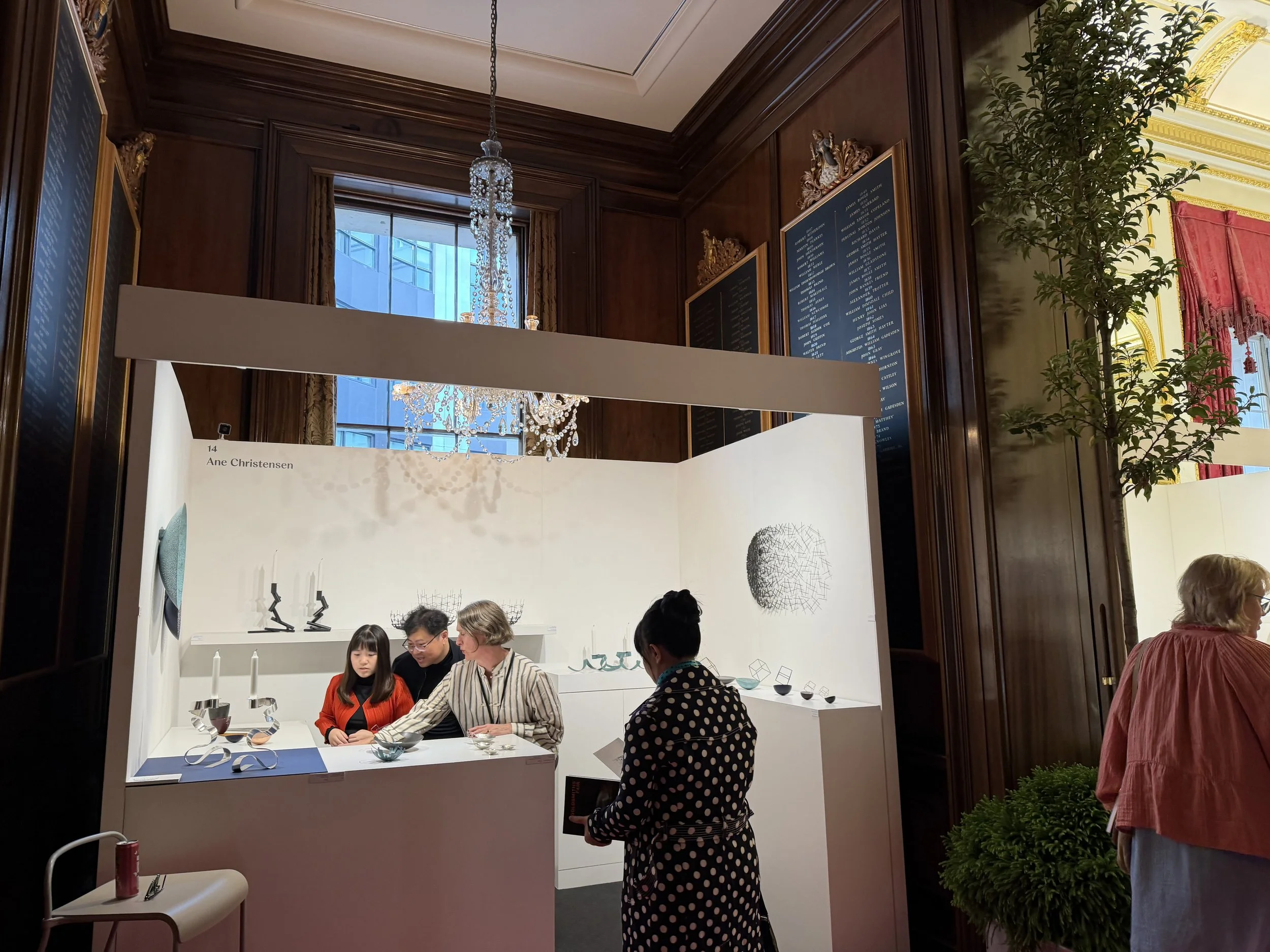
Ane Christensen Goldsmith Fair 2026 stand 14

Ane Christensen's piece displayed downstairs in the lobby's open exhibition space.
I also seen what an event like Goldsmiths’ Fair does for the customer. It’s not only a room full with jewellery. It provides people the opportunity to meet the maker, ask questions, hold the work, understand the process, hear the tale straight from the person who made it. That's important. A photograph can show you the finished object but it can't necessarily show you the experience of discovering that a tiny detail exists for a very particular reason or that a technique has taken years to develop or that the person standing in front of you has been making jewellery for several decades.
This is when my brand strategist head inevitably starts thinking about what comes next. How much of the experience is carried on when the customer leaves the Fair? What happens next when they seek the maker on line? What do they recall? Can they still find them? Do they know how it works without the maker to tell them?”
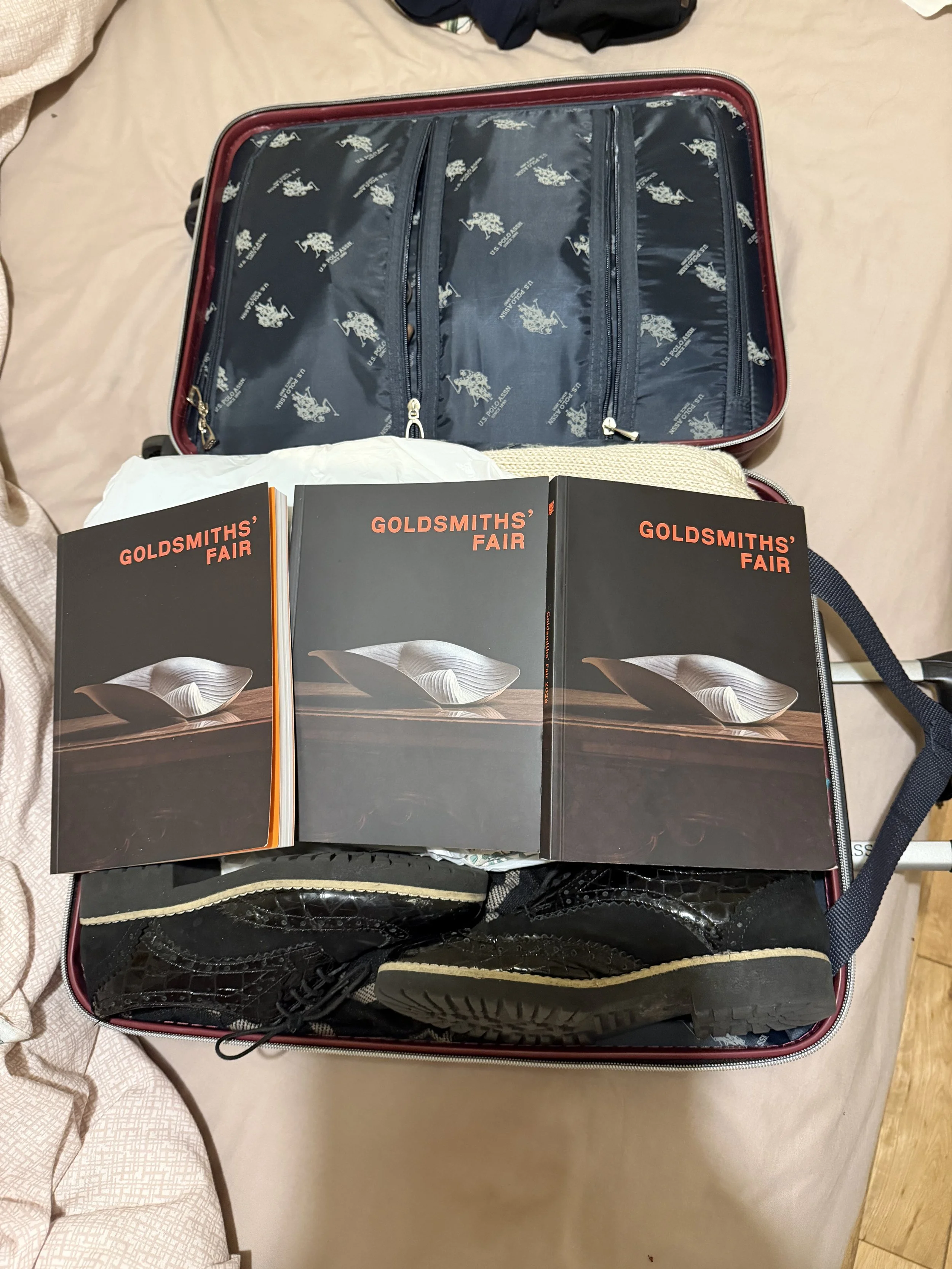
I enjoyed the printed Goldsmiths’ Fair directory for exactly this reason. I took 3 home. 😂 It’s a pretty basic bridge between physical discovery and digital discovery.” You see something you adore, you know who made it, you have their website, and you can find them again later. I've been thinking a lot about discoverability and SEO, but this was a reminder that discoverability isn't only about Google. It could start with an exhibition, a market, a shop, a recommendation, a printed directory or a chat with someone wearing the correct article of jewellery.
I went to Goldsmiths' Fair already thinking about what I'm calling Craft Signal Erosion, so of course I was looking at the things that were being made visible. The manufacturer was evident. It is possible to speak about the process. The skill was granted status. The work’s history may make its way into the discussion. The object was not entirely divorced from the person who built it. And that was one of the most powerful things for me being there.
I’ve spent a lot of time thinking about what happens when the language around craft, authorship, materials, and creation gets diluted, and when the value that’s already there in a piece of work isn’t clearly articulated. Goldsmiths' Fair felt like a place where those messages were being purposefully amplified, rather than lost.
And I think that's what I truly got out of my first week. Not a clean list of findings but a much stronger collection of questions about how makers talk about what they do, where authorship genuinely resides, how a creative process evolves and how much of that richness gets through to the customer.
I went to the Goldsmiths' Fair to look for jewellery. I started thinking about brand, language, education, making, authorship, customer experience and discoverability.
Which, considering what I do, should come as no surprise.
I didn't expect to return home with so many new questions.